Pouncing
Landing on a creature's head is Cosmo's only built-in attack, and it bounces him back up. Some creatures take several pounces. A very long fall leaves him dizzy for a moment but doesn't hurt.

Forbidden Planet
A fan site for the 1992 Apogee platformer about a green kid with suction-cup hands, a busted family spaceship, and a planet that wants to eat his parents. Every sprite, tile and backdrop here was pulled straight out of the shareware game files.

 0
0Cosmo's Cosmic Adventure is a side-scrolling platform game for MS-DOS, programmed by Todd J. Replogle, drawn by Stephen A. Hornback, scored by Bobby Prince and published by Apogee Software in March 1992. You play Cosmo, a small green alien with red spots, a mohawk, and suction cups for hands.
Like most Apogee games of the era, it came as a trilogy. Forbidden Planet: Adventure 1 of 3 was shareware: copy it, pass it to friends, upload it to your local BBS. Adventures 2 and 3 came in the mail once you ordered. Each adventure has ten numbered levels and two bonus stages, so thirty levels in all, plus a short cliffhanger finale at the end of Episode 1.
It runs in 16-color EGA at 320×200, with parallax backdrops behind maps built from 8×8 tiles, AdLib music, and PC speaker sound effects. It needs at least a 286. Scrolling moves in 8-pixel steps, which gives the game its slightly chunky feel. It looked and felt quite different from the smooth-scrolling Commander Keen games of the same years.
What makes it Cosmo, though, is the hands. Most platformer heroes treat walls as obstacles. Cosmo sticks to them.


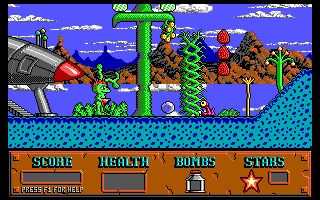
Retold from the game's own story screens, using the cartoon frames from CARTOON.MNI.

Tomorrow is Cosmo's birthday, and his parents are taking him to the one place every kid in the Milky Way wants to go: Disney World.


Suddenly a blazing comet zooms toward their ship, leaving no time to change course.

The comet slams into the ship and forces Cosmo's dad to make an emergency landing on an uncharted planet.

Down they go, trailing smoke toward a world nobody has a map for.
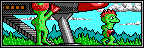
While his dad repairs the ship, Cosmo heads off to explore and have some fun.
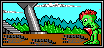
He comes back an hour later. Mom and Dad are gone. All he finds are strange, enormous footprints.
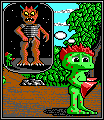
Has his family been carried off by a hungry alien to be eaten? Cosmo has to rescue his parents before it's too late.
Episode 1 sends Cosmo across the planet's surface: sunny mountain meadows, a dense forest, a spooky stormy wood, cliffs laced with roots, an ice cavern, rock walls bristling with machinery, a level up among the clouds, and mud geysers in the mountains. It ends on a genuine cliffhanger.
Episode 2 picks up right where that cliffhanger leaves off and gets stranger: the inside of a creature, mushroom fields at night, pipe works, caves, ice and crystals. Episode 3 heads through jungle and circuitry toward a futuristic city, and the story wraps up there.
Episode 1 ends with Cosmo plunging down a bottomless shaft toward an enormous open mouth: "Will Cosmo's parents be lightly seasoned and devoured before he can save them?" Episode 2 begins with him swallowed whole, and ends with Cosmo leaping through a hole in a cave ceiling to see the city where his parents are being held.
In Episode 3, once the creature is beaten, a big blue alien named Zonk explains that his people found Cosmo's parents and brought them somewhere safe, because the planet is dangerous. They had been searching for Cosmo all along. Zonk helped fix the ship, the family flies to Earth, parks on top of Space Mountain with their "inviso-cloak," and Cosmo has the best birthday of his life. "Look Ma! New Disney characters!"


Walk with the arrow keys, jump with Ctrl, drop a bomb with Alt, and press Up to look, use a transporter, or reread a hint.
The instructions put it plainly: "Cosmo has a very special ability: He can use his suction hands to climb up walls." Jump or fall into a wall while pushing toward it and Cosmo slaps on and stays put. Tap jump to let go. Push back into the wall and he sticks again. Chain those together and he climbs, hop by hop, up shafts most platformer heroes could only look at.
Apogee's hint sheet called it an ability that "has never been seen in a game before," and the levels are built around it. Several maps are 256 tiles tall, with the exit at the top or bottom of a long vertical climb. Walls become routes. Secret areas sit at the top of ledges you can only reach by clinging. While clinging, Cosmo can look up and down to scout the shaft, which is exactly what you want before letting go.
The game keeps the trick from becoming trivial. Only some wall surfaces are grippable: each wall tile carries its own "can cling" attribute. Ice is too slippery to hold, and icy slopes send Cosmo sliding. And he can't plant bombs while hanging on a wall.
Landing on a creature's head is Cosmo's only built-in attack, and it bounces him back up. Some creatures take several pounces. A very long fall leaves him dizzy for a moment but doesn't hurt.

You start each episode with none and can carry nine. A bomb is set down two tiles ahead of Cosmo, not thrown. It flashes and goes off, and it hurts Cosmo too. Explosions also set off any bombs lying nearby, like a fuse.

Green bars on the status bar. You start with three and survive three hits; the fourth is fatal. Power-up modules refill a bar. A rare hamburger adds a whole new bar, up to five.


Fruit, vegetables, gems and stranger snacks hang everywhere and score from 200 to 3,200 points. Barrels and baskets hide more, so pounce or bomb them open.
Worth 200 each, and every two levels each one cashes in for 1,000 more. Bank 25 to reach a bonus stage, or 50 for the better one.


There are no keys. Bump a colored head switch from below to open the door of the same color. Floor switches need four pounces and start platforms, raise hidden walls, switch on lights, or shut off force fields.


Springs fling Cosmo high into the air, and the first one earns a "Whoa!" Ceiling-mounted pads push him back down, and Jump Pad Robots are springs that walk.


Stand on a transporter and press Up. Jump into a pipe inlet and get sucked through the plumbing. Some levels add moving platforms, mud geysers to ride, rockets, and a scooter that lets Cosmo fly anywhere.
Glowing globes on stalks. The first one on a level reads itself to you; press Up to read one again. Bomb one for 12,800 points.


Several levels hide walled-off rooms full of prizes. Follow trails of floating objects, look up from high places, and get suspicious of any wall you can cling to.


Spikes on floors, walls and ceilings, spears, arrow pistons, saw blades, crushers, flames, dripping leaks, force fields and bear traps. Bottomless pits restart the level.

The invincibility cube wraps Cosmo in a protective bubble for about twenty seconds. The scooter turns a level into a free-flight treasure hunt.
Three adventures, all titled Forbidden Planet. Only the first was shareware.
The shareware episode, and the one the files on this site come from. It's a tour of the planet's surface and teaches nearly everything: clinging, pouncing, bombs, barrels, hint globes, switches and doors, transporters and pipes, scooters, satellites and force fields.
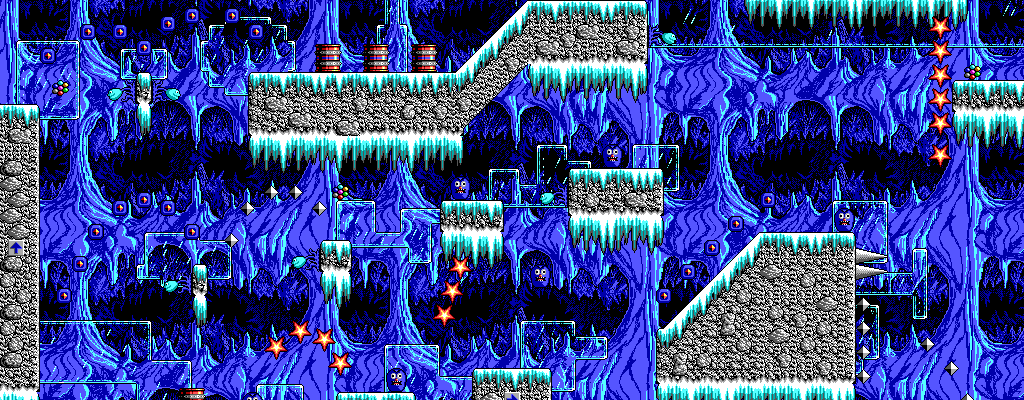
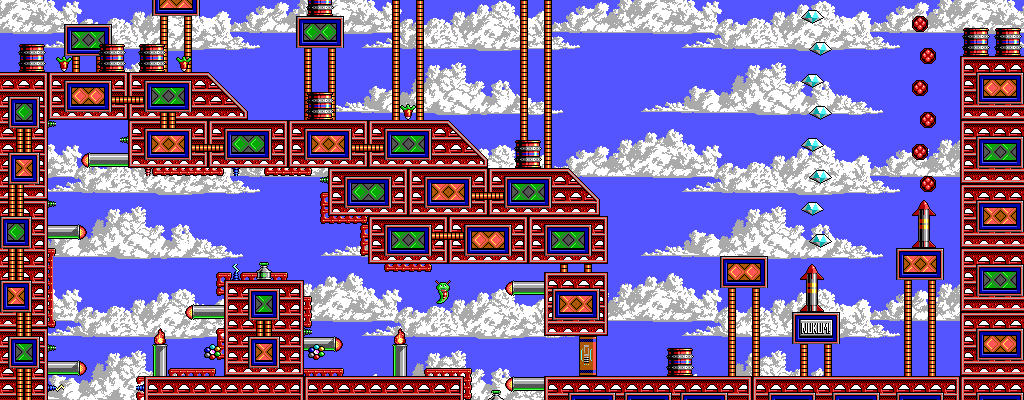
The environments change with nearly every level. A1 and A2 are bright meadows under brown mountains, and A3 is a deep forest with a scooter hidden in the treetops. A4 is a scraggly wood in the rain, with lightning that flashes the whole sky white. A5 and A10 are tall root-tangled cliffs, A6 is an ice cave so slippery Cosmo can barely stand, and A7 is a rock face wired with machinery and color-cycling lights. A8 floats in the clouds and A9 runs past mud geysers.
A10 ends with a boss that takes twelve pounces, and the short A11 finale drops Cosmo into the cliffhanger. The two bonus stages are a tall star shaft and a long star corridor.
Open the Episode 1 map atlas: every map, rendered at full size from the level files.
Registered players picked up exactly where the cliffhanger left off, in a level that looks just like the one Episode 1 ended on, except this time the creature at the bottom wins. B2 takes place inside it, against a backdrop of internal organs, with ghosts, eggs that hatch baby ghosts, and red liquid dripping from the walls.
From there it's mushroom fields under twinkling night skies (B3, B4), a pipe works (B5), stalactite caves full of worms (B6), diagonal ice spires (B7), crystal caverns (B8), mountains (B9) and circuit panels (B10). Episode 2 introduces the towering Red Jumper, which takes seven pounces and leaves a star, plus a guest star frozen in a block of ice on B7.
There's no boss. Episode 2 ends with Cosmo jumping through a hole in the cave ceiling.


Episodes 2 and 3 were never shareware, so their maps aren't in the files this site was built from. The creatures above come from the shared sprite file (ACTORS.MNI is identical in all three episodes). Map appearances are taken from Cosmodoc's actor and map tables.
The finale gets mechanical. After a rainy jungle (C1), where the level ends when an Exit Monster eats Cosmo, and one more trip through creature innards (C2), Episode 3 is all printed circuit boards (C3), crystal shafts (C4), pipes (C5), dense conduit panels (C6, C7) and blue brick tech (C8), ending in a futuristic city at night (C9, C10).
New hazards come with the setting: wall launchers spitting fireballs, big circular saw blades, and a light switch that makes the Sentry Robots start shooting. ("WARNING: Robots shoot when the lights are on!") C10 ends with a boss that takes eighteen pounces and launches parachuting Blue Balls while you work on it.

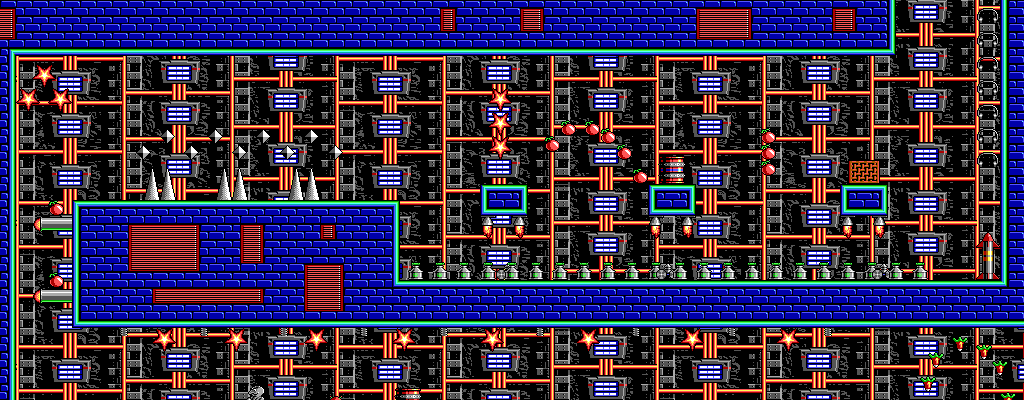
The machinery in this band comes from map A7. The tech tiles live in the same shared tile file as Episode 3's circuitry, and the light cycling behind it is A7's real palette animation.
The planet's residents, drawn from ACTORS.MNI. Names follow Cosmodoc's actor database; behavior and points come from the reconstructed game code.
Red Chomper Creature
The first thing on the planet that wants to bite you. Patrols back and forth, sometimes stopping to look around. It's the creature in the game's "jump on top of creatures" reminder.

Blue Ball / Parachute Creature
A hopping blue blob that bounds toward Cosmo. Tulip plants and the final boss launch them, and they float back down on little parachutes.
Ghost
It only creeps toward Cosmo while his back is turned, and freezes when he faces it. Beat one and a baby ghost hops out.
Floating Moon
A hovering crescent that turns to keep its face on Cosmo.
Red Jumper Creature
The biggest regular creature on the planet: a long-legged red thing that leaps at Cosmo. It takes seven pounces, and the hint sheet points out it leaves a star behind when it goes. Registered episodes only.
Jumping Baby Ghost, Baby Ghost Egg
Hops up and down. Baby ghosts hatch from eggs that crack when Cosmo gets close or pounces on them, and one pops out of every Ghost you beat.
Suction Feet Creature
Cosmo isn't the only one with suction cups. This one walks along floors and ceilings and flips from one to the other.
Blue Bird
Perches, then swoops down at Cosmo in arcs. Watch the treetops in A3.
Dragonfly
Flies back and forth on a fixed line. Pouncing just bounces you off, which can make it a handy stepping stone. According to the code, bombing one is worth 50,000 points, if you can manage it.

Pink Worm
Harmless to touch, but pounce on it and it leaves a puddle of harmful goo behind. Hence the four-globe warning in B6: "Don't... step... on... worms..."
Flying Roamer Slug
A friendly wanderer that drifts in every direction. Each time Cosmo touches it, it spits out a gift: a gourd, a tomato, a diamond or an emerald. After three it vanishes.
Spitting Turret Creature
A squat, spotted blob with a cannon for a nose. It swivels to aim at Cosmo and spits in five directions, from straight west through straight down to straight east.
Translucent Pusher Robot
A see-through robot that shoves Cosmo away ("Umph!"), usually toward something worse.
Sentry Robot
Patrols and fires. On levels with a light switch it only shoots while the lights are on, and only a lights-off pounce stuns it.
Jump Pad Robot
A walking springboard. It doesn't hurt Cosmo, and bouncing on it launches him like a jump pad.
Sharp Spike Robot
A drill-headed robot that runs back and forth along a floor, or a ceiling in later episodes. Don't try to land on it.
Electric Beam Robot
Rolls along, shooting an electric beam straight up. Bomb it and the beam turns into a column of stars, one of the best tricks in A7.
Spark
An electric spark that crawls along walls and edges, the kind of surfaces Cosmo wants to cling to.
Eye Plant
A plant that does nothing but watch you. Harmless. Bomb one and it drops a free bomb, and bombing fifteen on one level earns a secret 50,000.
Clam Plant
Opens and snaps shut. A hint globe in A5 spells out the timing: "The Clam Plants won't hurt you if their mouths are closed."
Red Heart Plant
Looks like a flower until Cosmo passes directly over it, and then it snaps open.
Spitting Wall Plant
Grows out of a wall and spits a projectile at regular intervals, often right where you'd like to cling.
Tulip Launcher Plant
Drop into it and it swallows Cosmo, then fires him high into the air ("Whoa!"). It also launches parachuting Blue Balls. Two bombs destroy it.
Ivy Plant
A column of leaves that rises out of the ground. Bombs don't kill it; they just make it duck back down for a while.
Hopping Cabbage Creature
A snapping green head of cabbage that hops toward Cosmo. One of a handful of creatures found only in Episode 1.
Flying Wisp Creature
Bobs up and down in place in the ice caves. Nothing destroys it, so time your jumps.

Jumping Bullet Creature
A tiny armored thing that springs back and forth in arcs. Only on A10.


Stone Head Crusher, "Two Tons" Crusher
The stone head drops when Cosmo walks underneath. The "Two Tons" weight slams down on a spring, over and over.
Exit Plant
Not an enemy at all. The way out of A4 is to let this plant swallow you. Episode 3's C1 has an Exit Monster that does the same job.
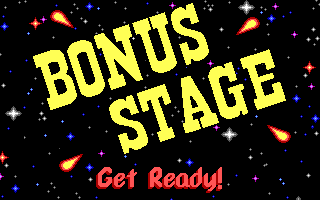
The bonus-stage starfield seemed like the right place to talk about points.
Hamburger+1 maximum health bar (up to 5), 12,800Bomb+1 bomb (carry up to 9), 100Tomatoes, pears, onions200 Gourds, roots, pods, candy corn…400Grapes, berry vines, bananas800
 Diamonds, octahedrons, headphones800Barrels and basketsPounce 100, bomb 1,600, plus what's inside
Item names are descriptive, from Cosmodoc. The game never names its prizes on screen.
| Defeat a boss | 100,000 |
| Each secret bonus (see Secrets) | 50,000 |
| Destroy a Monument (3 bombs) | 25,600 |
| Bomb a hint globe | 12,800 |
| Pounce a parachuting Blue Ball | 12,800 |
| Bomb a Flying Slug | 12,800 |
After every two levels the game stops for a "Super Star Bonus" and counts your stars out at 1,000 apiece. As the count climbs it ranks you, one rank per eight stars: Not Bad!, Way Cool, Groovy, Insane, Gnarly, Outrageous, Awesome!, Brilliant!, Profound, and finally Rocket Scientist. (Three more ranks, Radical!, Incredible and Towering, are in the data but a bug keeps them from ever appearing.)
Bring 25 stars and you go to the lesser bonus stage. Bring 50 and you get the better one.
Each score pops up and drifts away when you earn it. The 6,400 sprite exists in the data but is never used.
Every hint globe message in the game, word for word, typos included.
These hint globes will help you along your journey. Press the up key to reread them.
Adventure 1, map A1
| Message | Where |
|---|
Pull one of these off and a speech bubble pops up: 
Press C + 0 + F10 together during play. "You are now cheating! You have been awarded full health and maximum amount of bombs!" It also raises Cosmo to the full five health bars. It works once per game, unless you abuse a save game, which Cosmodoc lists as a bug.
The reconstructed source shows a debug mode toggled by Tab + F12 + Del. With it on, hold F10 and press G for god mode, W to warp to a level, M for a memory report, or E+N+D to win the episode on the spot.
The old "COSMO1 apogee" command-line trick that shows up in cheat lists isn't a cheat at all. Cosmodoc explains that any unrecognized argument is taken as the save path, and one side effect makes Cosmo's health wrap around after he dies.
On level 7 of Adventure 2, a familiar blond hero is frozen solid. Bomb the ice and he thanks Cosmo:
"I'm Duke Nukum, green alien dude. Until you rescued me, I was stopped cold by an alien invasion force!"
"Sorry, kid, I've got to save the galaxy… but, I can give you something that will help you out."
"Just look for me in my next exciting adventure, Duke Nukum II!" … "See ya… and have those spots checked…!"
He leaves a hamburger and jetpacks off. "Nukum" was the official spelling for a brief while.
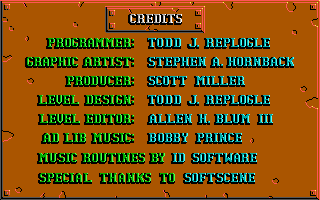
Cosmo landed between Duke Nukem (1991) and Duke Nukem II (1993). Todd Replogle, about 22 at the time, wrote the code and built the maps. Stephen Hornback, Apogee's first staff artist of the decade, drew everything you see on this page; Cosmo appears to be his first credit. Hornback died in 2016. Bobby Prince wrote the AdLib soundtrack, which includes a menu theme that is a riff on ZZ Top's "Tush." He died in June 2026. The music playback code was id Software's.
The game reportedly went through the working titles "The Adventures of Zonk" and "Cosmo Kid from Space." Duke Nukem II is widely reported to run on an updated version of Cosmo's engine, and the two games share file formats. Thirty years later, Replogle was blunt about why Duke became a star and Cosmo didn't: "Cosmo was a game designed for kids. But I also think the game failed because of bad level design. I constructed all the maps. Also, we should have made Cosmo 3D, then he'd be famous too!"
That's too harsh. Computer Gaming World called it "especially playable and extremely addicting" in 1993, and three decades later it's one of the best-documented DOS games around.
The shareware episode's ordering screen: "Order all three adventures for only $35, plus $4 shipping." Calls went to 1-800-426-3123, and the game also pointed you to the Software Creations BBS. Registering got you Adventures 2 and 3, a hints and tricks sheet, and "The Secret Cheat password." The COSMO1 zip was about 525 KB, which Cosmodoc reckons is almost five minutes at 14.4k.
Later copies came with an ORDER.FRM fax sheet listing Cosmo at $34.95, between Boppin' and Crystal Caves. Today it's sold on GOG and Steam, and as part of the 3D Realms Anthology.
| Bart | 1,000,000 |
| Lisa | 900,000 |
| Marge | 800,000 |
| Itchy | 700,000 |
| Scratchy | 600,000 |
| Mr. Burns | 500,000 |
| Maggie | 400,000 |
| Krusty | 300,000 |
| Homer | 200,000 |
The sky fortresses of A8 are signposted with tiles reading APOGEE, HEY YOU and NUKUM, a year before Duke turned up in person on B7. The RED ALERT sign sits in the same tile file but isn't used anywhere in Episode 1.


Found by checking every Episode 1 map for these tile numbers while building this site.
Bobby Prince's track titles, from Cosmodoc's music database: "Just About Going Wacky" (A1, A2), "Drums" (A3), "Run Away" (A4), "Teck 4" (A5), "Caves" (A6, A11), "Devo" (A7, A8), "Easy 2" (A9), the ZZ Top riff (A10 and the menus), and "Da Do Da" for Episode 1's bonus stages. Later episodes add "Scarry," "Bells," "Tek World," "Rock It," "Circus," "Teck 2," "Teck 3," "Boss," and the gloriously named "Cosmo's Foggy Cosmic Breakdown."
Everything on this page was extracted from COSMO1.STN and COSMO1.VOL, the data files of the freely distributable shareware episode. The group files hold dozens of .MNI entries. Tiles are 8×8 EGA images stored as interleaved bit planes (blue, green, red, intensity, plus a transparency mask for sprites). ACTRINFO.MNI says how to assemble those tiles into each of the 267 actor sprite sets. The level files list every tile and actor position, so the maps in the atlas are rendered from the original data, with the original backdrops tiled behind them.
The site uses the game's sixteen EGA colors and its own bitmap font, from FONTS.MNI. The lightning in the story section and the color cycling behind Episode 3 imitate the game's palette animation: EGA color 5 is cut out of the art and the color behind it changes. The extraction scripts are in the tools/ folder, based on the formats documented by Cosmodoc.
This is an unofficial fan project. Cosmo's Cosmic Adventure is © Apogee Software / 3D Realms, and its graphics belong to their owners.